Hyperflow — the flexible technology.
A universal zinc-based battery platform. One cell architecture supports multiple safe, non-flammable chemistries and three operating modes — static, flow, and hybrid flow — without any change to the hardware. And it is upgradeable: a better electrolyte means a better battery — no replacement needed.

One platform. Many possibilities.
Hyperflow is Cayrex's core technology — a zinc-based cell architecture built around zinc-bromine (Zn-Br) as its core chemistry. Zn-Br delivers the best balance of energy density, cost and maturity, and it is the chemistry every Hyperflow battery is designed and tested for.
When an application calls for it, the same battery can also run on other zinc-based chemistries — such as Zn-Mn or Zn-I — without any change to the cells or the battery. Only the electrolyte changes. This keeps the platform open to lower-temperature operation, higher power or longer cycle life, and protects it from raw-material price swings.
The system operates in static and hybrid flow modes using the same cells — the compactness of a static battery with the scalability of a flow battery.
Buy it once. Keep upgrading it.
With Hyperflow, the goal is to buy the battery once and keep upgrading, repairing and adapting it for years. Instead of replacing the entire battery when technology improves or a component reaches the end of its life, the battery can evolve with its owner.
Think of it like a 3D printer. You don't throw away the entire printer when the hotend wears out or when a better build plate, stepper motor or other component becomes available. You simply replace or upgrade that part. If something breaks, you repair or replace the affected component instead of buying a completely new machine.
Hyperflow follows the same philosophy: if one part becomes outdated or fails, replace or upgrade that part — not the entire battery. This reduces waste while extending the useful life of the system.
Two operating modes, one architecture.
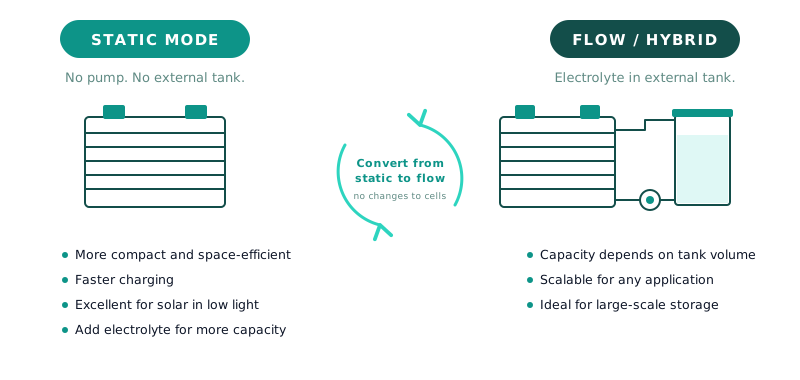
Hyperflow supports two distinct modes of operation on the same cell architecture — static (no pump, no external tank) and hybrid flow (intermittent pumping driven by voltage). Switching between them requires no modification to the hardware.
Compact, fast, independent
In static mode, the battery operates without a pump or an external electrolyte reservoir. The pump and reservoir remain inactive, and the battery functions solely as a cell stack.
This configuration allows the battery to work in two ways: either as a system where the pump and electrolyte tank are connected but inactive, or as a completely independent battery stack without any connection to an external electrolyte supply.
The latter setup reduces overall system size, making it more compact and space-efficient. Additionally, this mode enables faster recharging, though the capacity depends entirely on the amount of electrolyte stored within the cells.
Static mode is particularly advantageous for charging from solar panels during low sunlight conditions or other scenarios with limited charging energy. If additional capacity is required, more electrolyte can be added to the system.
Scalable, efficient, intermittent
In hybrid flow mode, the electrolyte is stored in an external reservoir and the battery's capacity is determined by the total volume of electrolyte available — in both the cells and the reservoir — making the system scalable to any application size.
Unlike classic flow batteries (e.g., VRFB, all-iron flow, or Zn-Br systems) where the pump runs continuously, the Hyperflow battery does not require constant pumping. Instead, the pump activates only when the cell voltage drops below a threshold, briefly refreshing the electrolyte at the electrodes.
The pump runs for just a few minutes to create a flow loop, then turns off again. This intermittent operation significantly improves energy efficiency — less parasitic consumption, less wear on the pump — while keeping the scalability of a flow battery.
Hybrid flow adapts to the load. At low demand the battery runs almost like a static battery and the pump rarely switches on. As demand grows, the pump runs more often, and at high power it simply runs continuously, like in a classic flow battery. This makes it especially practical for small and medium-power applications such as homes, telecom and commercial storage.

From static to flow, with a simpler architecture.

A battery that gets better over time.
Battery performance in Hyperflow is driven almost entirely by electrolyte properties — cycle life, energy density, operating temperature range, and power delivery. The battery hardware is designed as a long-lived platform; the electrolyte is the part that evolves.

Refresh the electrolyte, keep the battery.
When capacity falls to 80–70% of nominal, the battery doesn't need to be replaced — it needs to be refreshed. Swap out the used electrolyte, replace it with a new one, and the battery is restored. The old electrolyte is recovered, reformulated and returned to production. The cells, the stack and the housing stay in service for the next cycle of life.
The fresh fill can be the same formulation, an improved one, or a different zinc chemistry altogether. The owner pays for new electrolyte rather than for a new battery system — and our development work can concentrate on the electrolyte, where most of the performance is decided.
The result: a dramatic reduction in cost of ownership compared to lithium or lead-acid systems, where capacity loss means a full-unit replacement.
This architecture turns a battery into a product that compounds in value. Every improvement to electrolyte chemistry — in our lab or in the broader scientific community — translates directly into an upgrade for every installed Hyperflow unit. The platform doesn't become obsolete; it keeps getting better.
Made of units you can reach and replace.
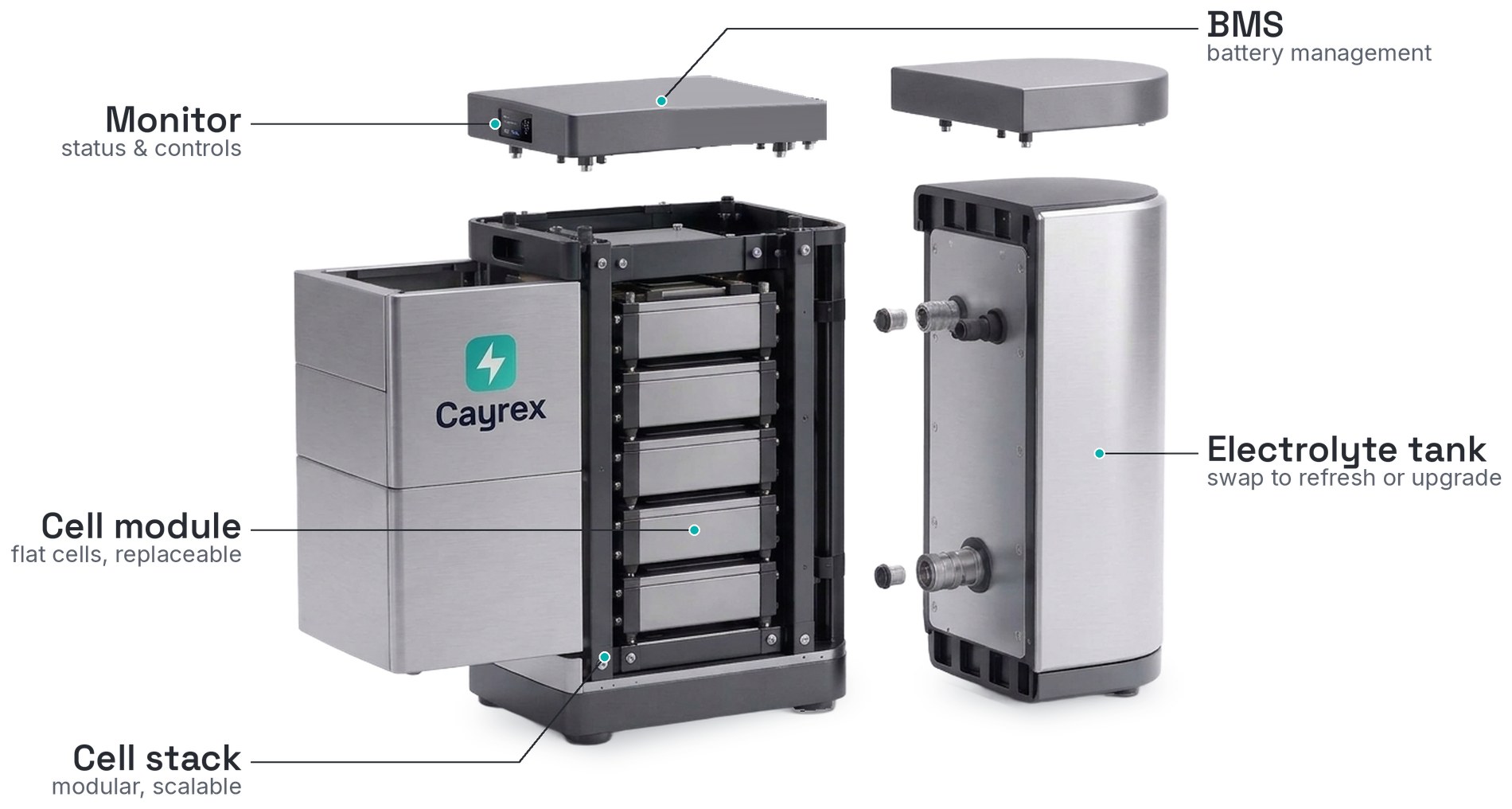
The Hyperflow system concept is assembled from separate units rather than sealed into one box: a battery management system with a monitor for status and controls, a stack of flat, replaceable cell modules, and an electrolyte tank. Each unit can be taken out on its own — to service it, to replace it or, in the case of the tank, to refresh or upgrade the electrolyte.
Begin with one module. Add more when you need them.
How big the battery becomes is up to its owner. The starting point is the base unit with a single cell module. A second and a third module can follow at any time; with all three in place the battery works as a static system of roughly 4–5 kWh.
If more storage is needed later, a tank holding 10–20 kWh of electrolyte is connected and the very same battery runs as a full Hyperflow system. Each step builds on what is already installed — nothing has to be bought twice.

Why Hyperflow.
Self-healing protection against zinc dendrites
Zinc dendrites are the classic failure mode of zinc batteries: they grow during charging and can short-circuit a cell. Hyperflow cells contain a self-healing material that stops dendrites before they can cause a short, so the cell recovers instead of failing. Developed in-house and tested in our laboratory cells.
Upgradeable — not replaceable
Performance is upgraded simply by replacing the electrolyte with an improved one — more capacity, more power, wider temperature range — with no change to the battery. Every advance in electrolyte chemistry becomes an upgrade for every installed unit.
Multi-chemistry platform
Supports Zn-Br, Zn-Mn and Zn-I electrolytes in the same hardware. Chemistry can be selected per application — or swapped later — without any change to the battery.
Static or flow mode
The same cells work as a static battery, a flow battery, or in hybrid flow mode. Convert from one mode to another with no cell modifications.
Intermittent pumping
In hybrid flow mode, the pump activates only when cell voltage drops below a threshold — a few minutes at a time. Low parasitic consumption, less wear.
Refreshable and recyclable
At end of service life, the electrolyte is recovered and reformulated. Cells and housing stay in service. Lower cost of ownership, lower environmental footprint.
Safe, scalable, modular
Aqueous zinc chemistry — non-flammable, no thermal runaway. Modular stack scales from residential to commercial storage without redesign.
Hyperflow in the lab.



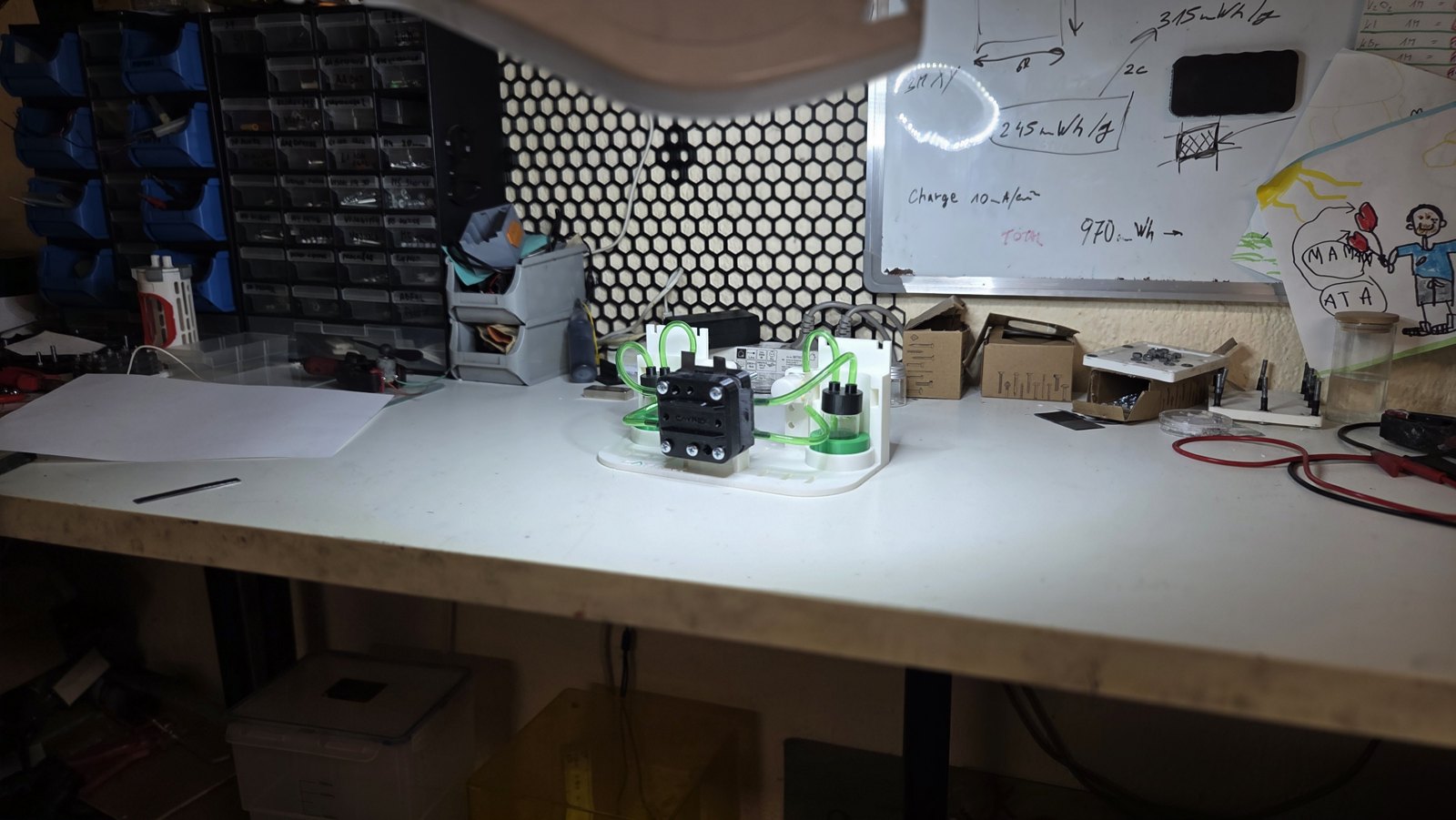
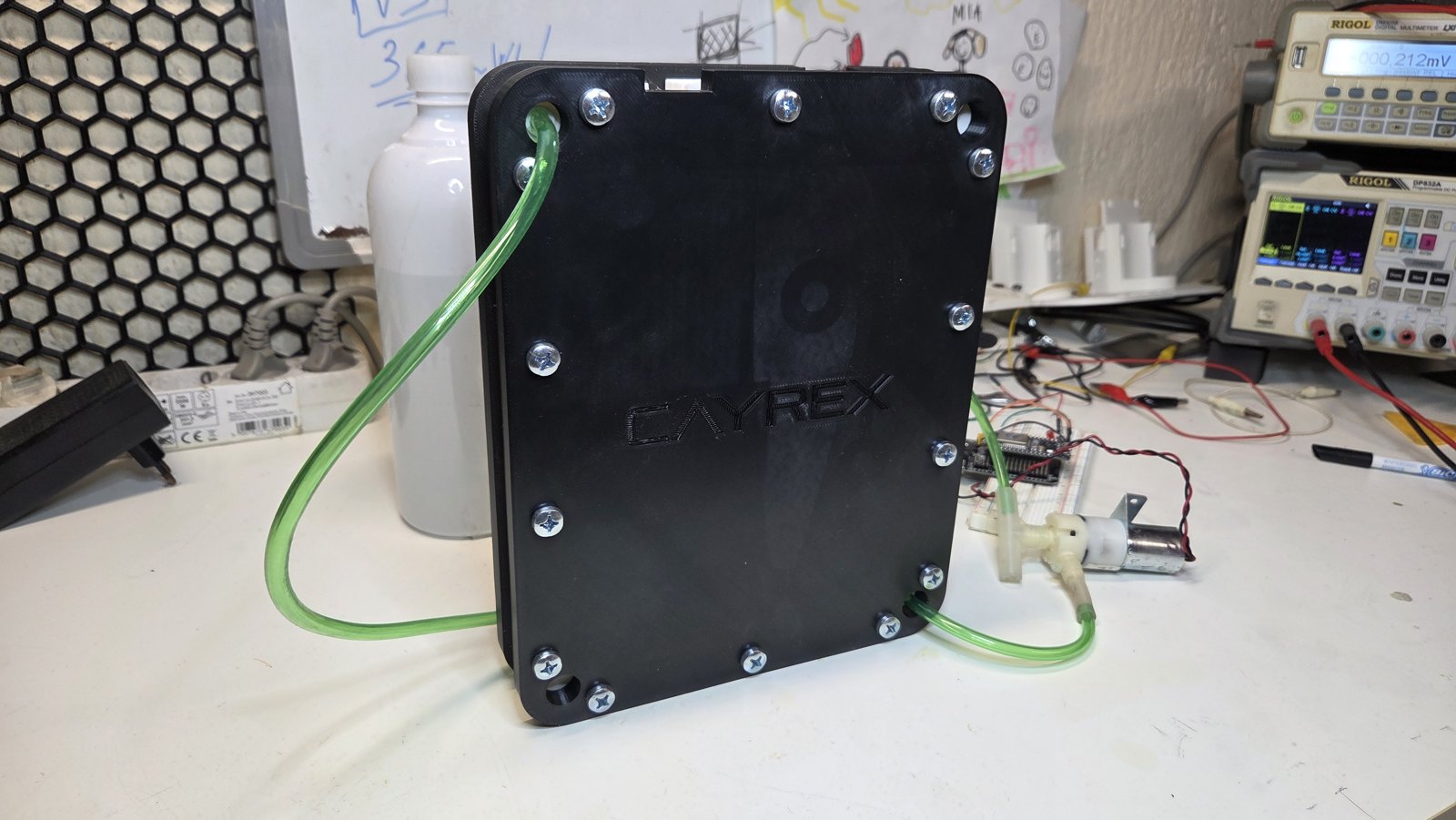


A better, more flexible flow battery.
Hyperflow is an actively developed deeptech project. You can follow our progress or support the development of this breakthrough technology.