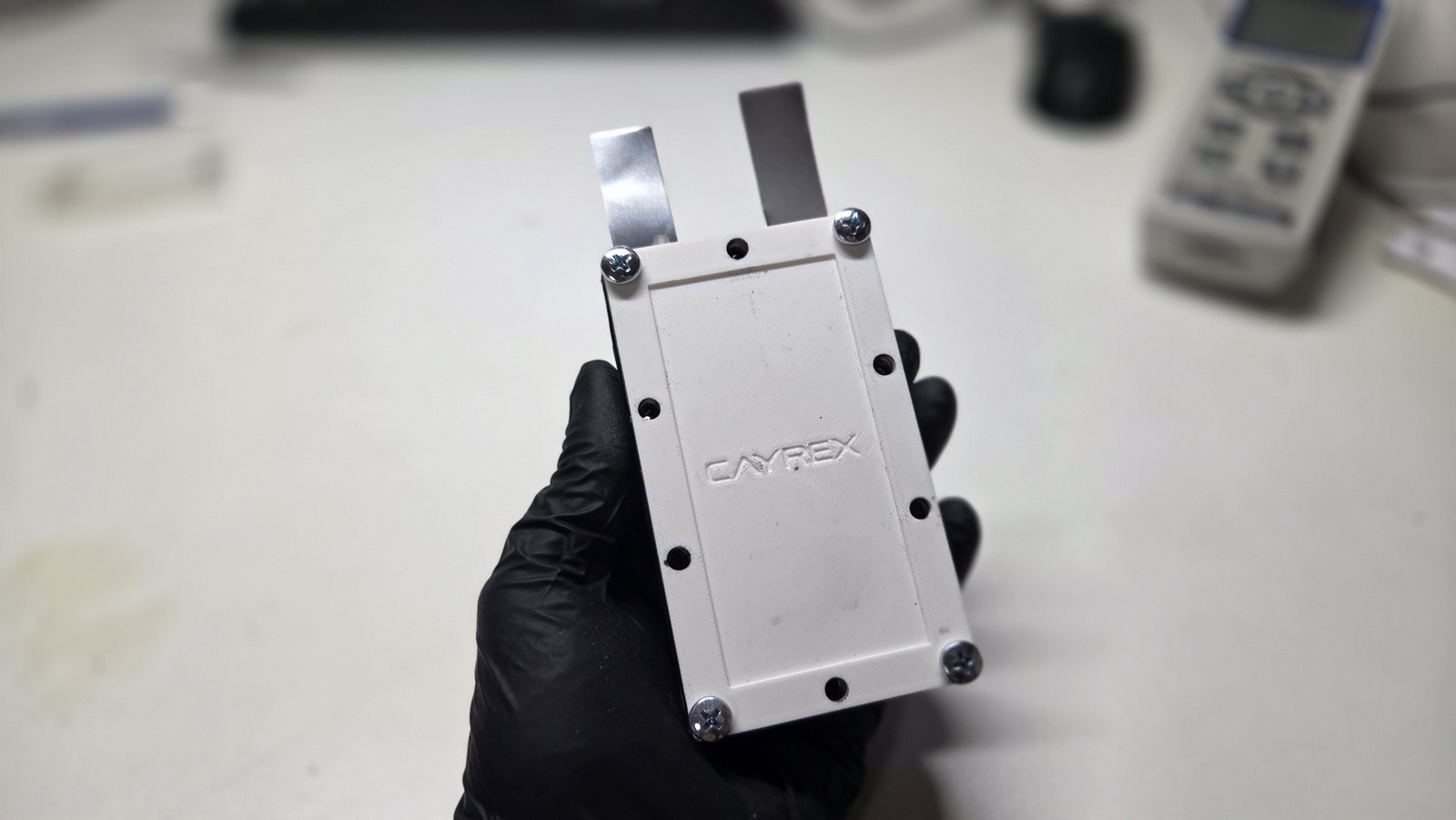
The Static zinc battery.

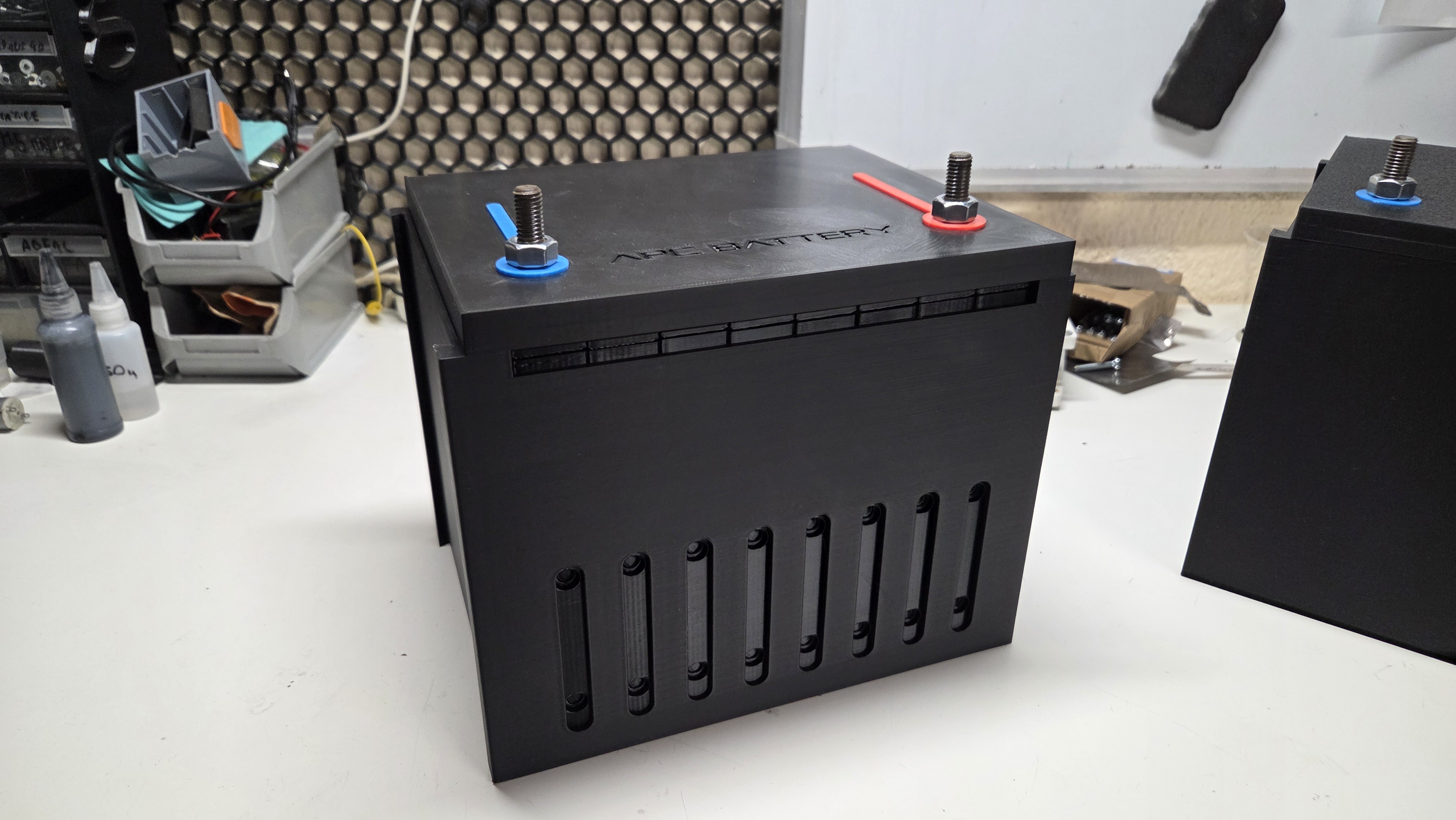
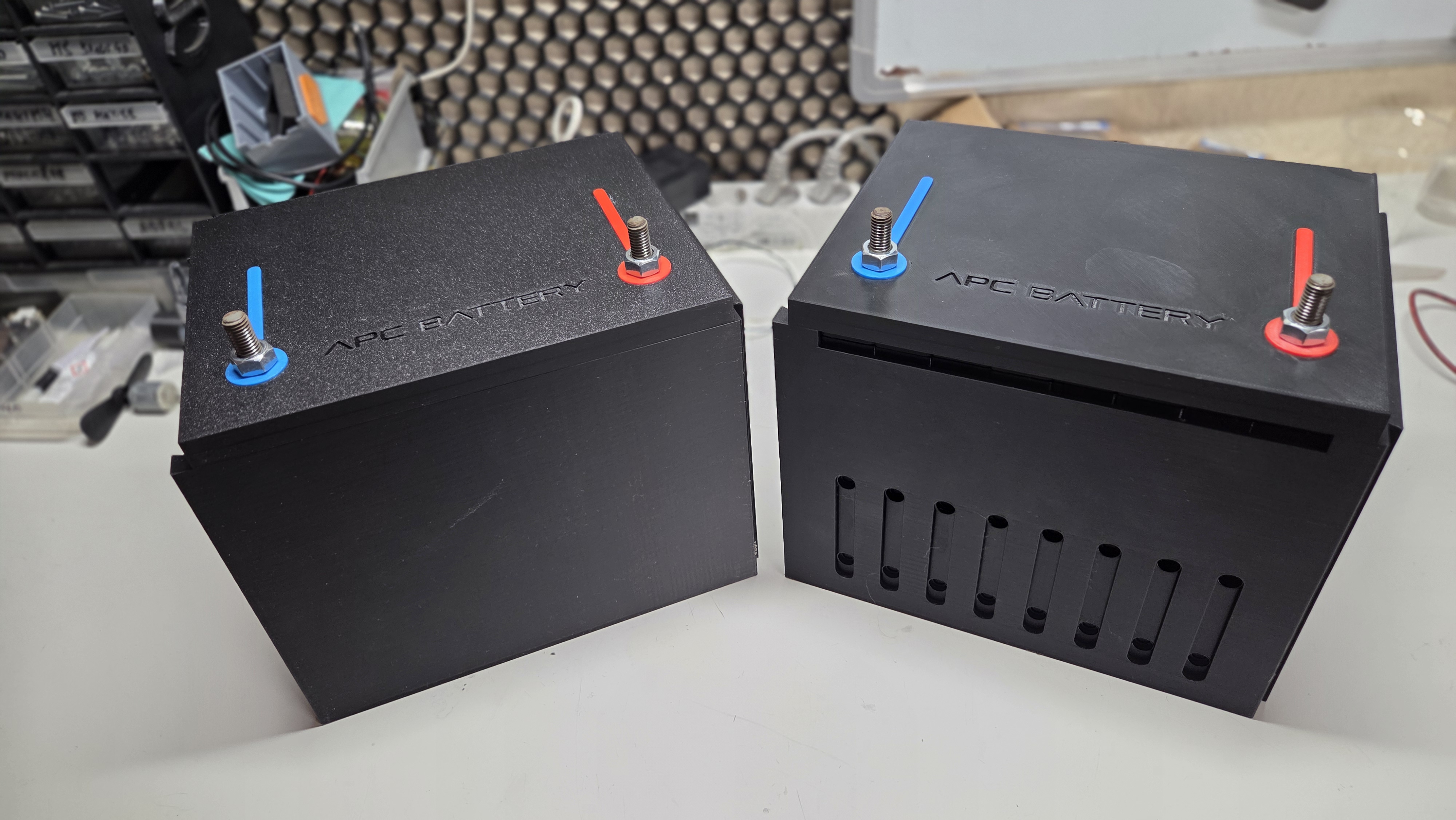
A compact, modular static zinc battery system built on Cayrex's Hyperflow platform — developing an affordable battery for the masses.

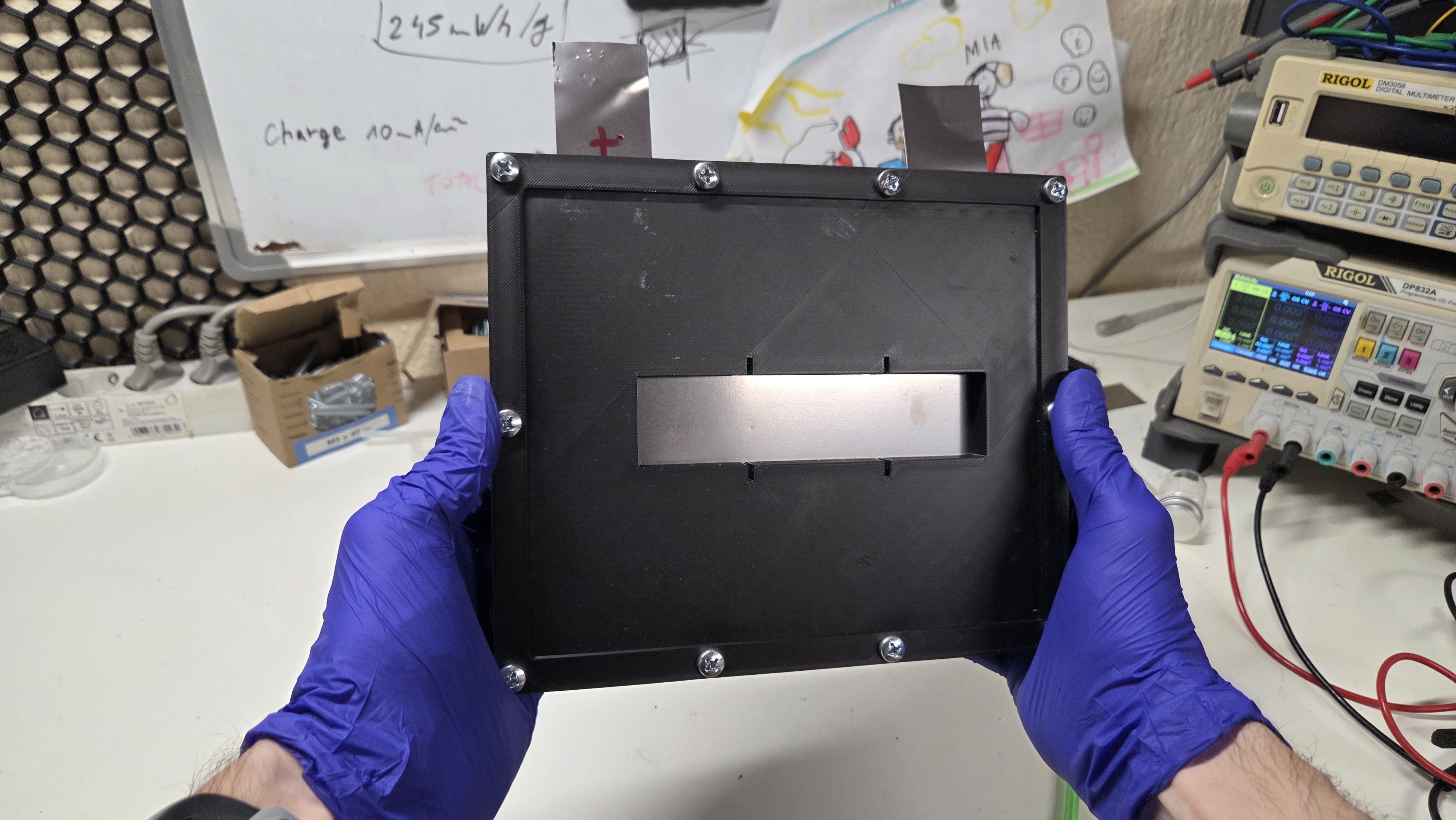
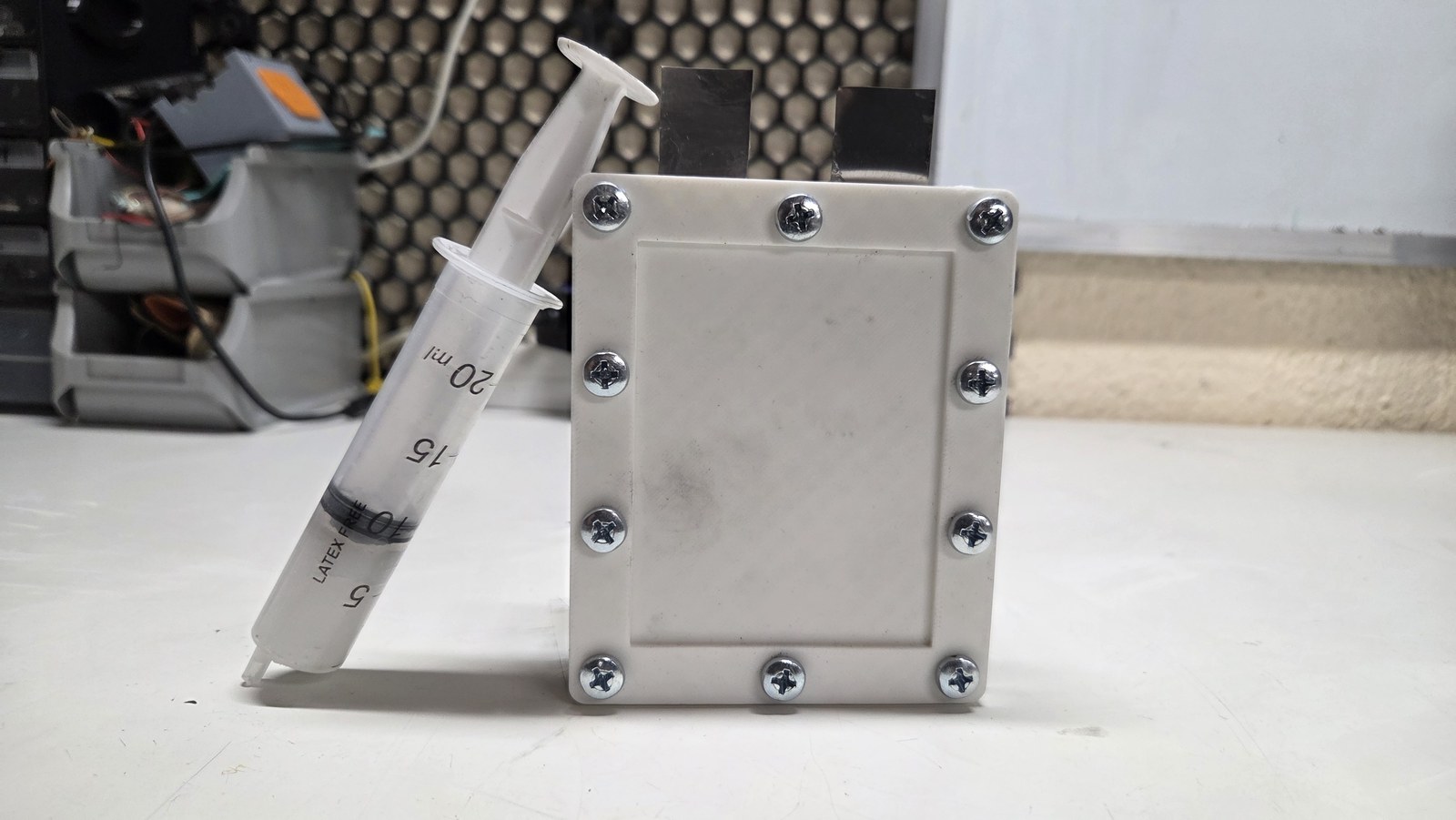
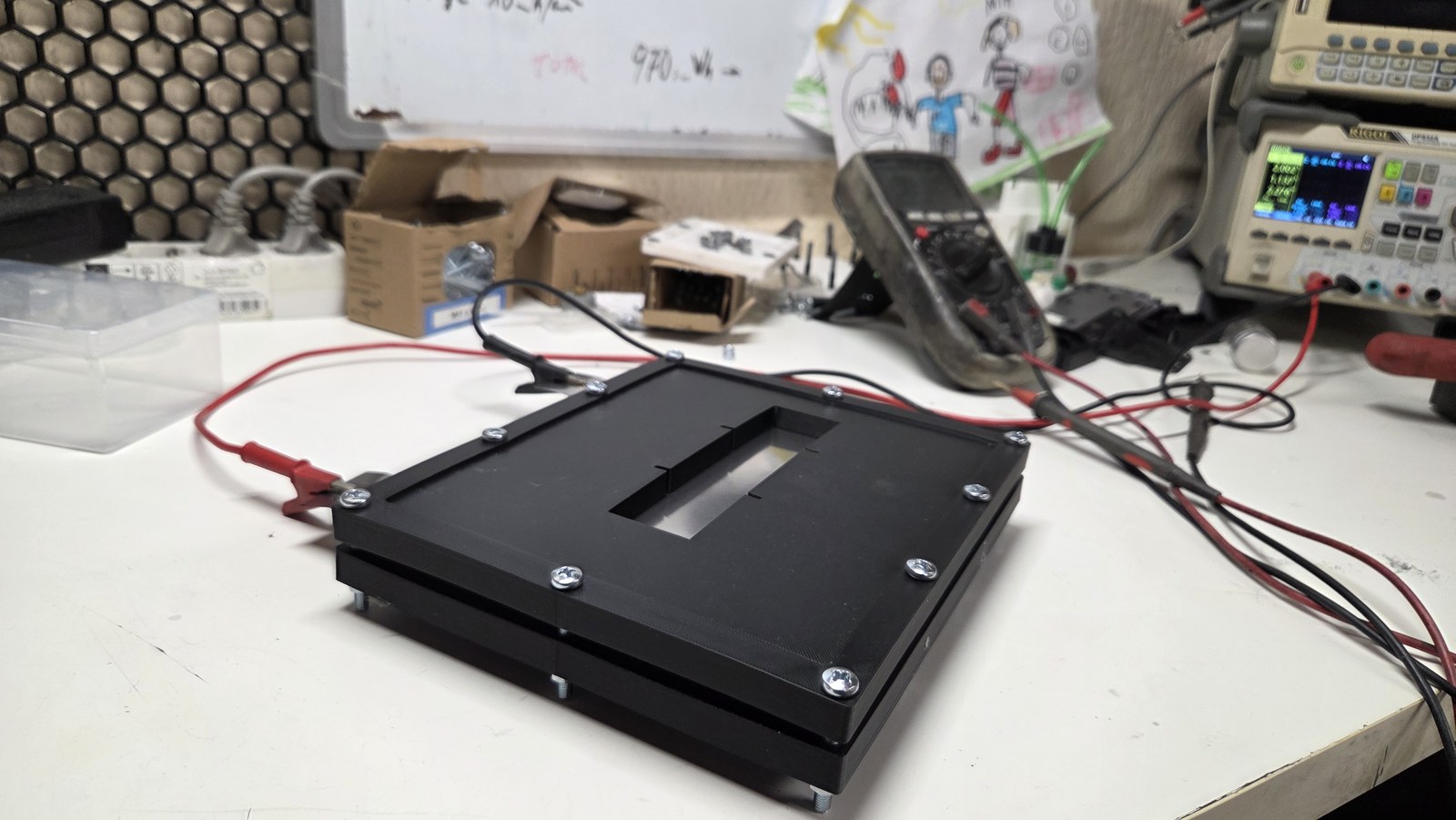
APC Battery FCD cell

About the APC Battery project

The APC battery is a compact, modular static zinc battery system developed by Cayrex, designed to challenge conventional lead-acid batteries. Built on the foundation of Cayrex's proprietary Hyperflow technology, the APC battery delivers good performance while maintaining the familiar compact form factor that industry and consumers already know. The APC battery is strategically positioned between lead-acid and lithium batteries — offering significantly better cycle life, safety, and upgradability than lead-acid systems, at a target price point currently comparable to AGM lead-acid batteries.

Unlike conventional batteries where the entire unit must be replaced when performance degrades, the APC battery can be upgraded or refreshed simply by replacing the electrolyte — a concept inherited from the Hyperflow platform that makes it uniquely future-proof. Which means that the APC battery will be better and better over the time, with each electrolyte upgrade. The APC battery comes with a zinc-bromine (Zn-Br) based electrolyte as its default chemistry. However, because it inherits the Hyperflow platform's universal cell architecture, users can opt for alternative zinc-based chemistries — including Zn-Mn, Zn-I, and Zn-Fe — based on their specific requirements, without any modifications to the battery hardware.

Built differently from the start.

Store for years — fully discharged

Lead-acid, lithium-ion and sodium-ion batteries all suffer from calendar aging — their capacity and performance degrade over time even when unused. APC can be fully discharged and stored for years without degradation.

Safe, zinc-based chemistry

Water-based zinc electrolyte is non-flammable and non-explosive — no thermal runaway, no toxic fumes. Zinc is abundant and ethically sourced, with no lithium, cobalt, or nickel supply concerns.

Upgradeable by electrolyte swap

The APC battery is built around two cell architectures — NCD (Neutral Cell Design) and FCD (Fixed Cell Design). With NCD cells, the battery can be refreshed or upgraded simply by replacing the electrolyte, no cell modifications needed. With FCD cells, upgrades are performed by replacing the cells themselves for higher capacity and power. Either way, the entire unit doesn't need to be replaced.

Multi-chemistry compatibility

One hardware platform, multiple electrolyte options — Zn-Br, Zn-Mn, Zn-I, Zn-Fe — without any modifications to the battery only by replacing of the electrolyte (NCD cell Architecture).

Long cycle life

Significantly more charge-discharge cycles than lead-acid systems, lowering total cost of ownership over the battery's lifetime.

Recyclable & sustainable

The battery can be refreshed with swaping the old electrolyte with new electrolyte only. And the used electrolyte can be recycled and reformulated for new production. Cell components are simple and easy to recover at end of life.

Built on Hyperflow

Inherits all the platform advantages of the Hyperflow technology in a compact, static form factor — without pumps, external tanks, or moving parts.

Two distinct cell architectures.

The APC battery is designed to accommodate two distinct cell architectures, allowing customers to choose the configuration that best matches their application requirements, performance needs, and budget.

NCD

Neutral Cell Design Architecture

The NCD architecture represents the simpler, more cost-effective approach. Cells are constructed with minimal components, making them extremely easy to manufacture and recycle. Any upgrade or chemistry change is accomplished purely by replacing the electrolyte — no cell modifications needed.

FCD

Fixed Cell Design Architecture

The FCD architecture is a high performance cell design that delivers higher capacity and power output than NCD. Upgrades are performed by replacing the cells themselves rather than just the electrolyte, offering greater performance potential at the cost of slightly more complex manufacturing.

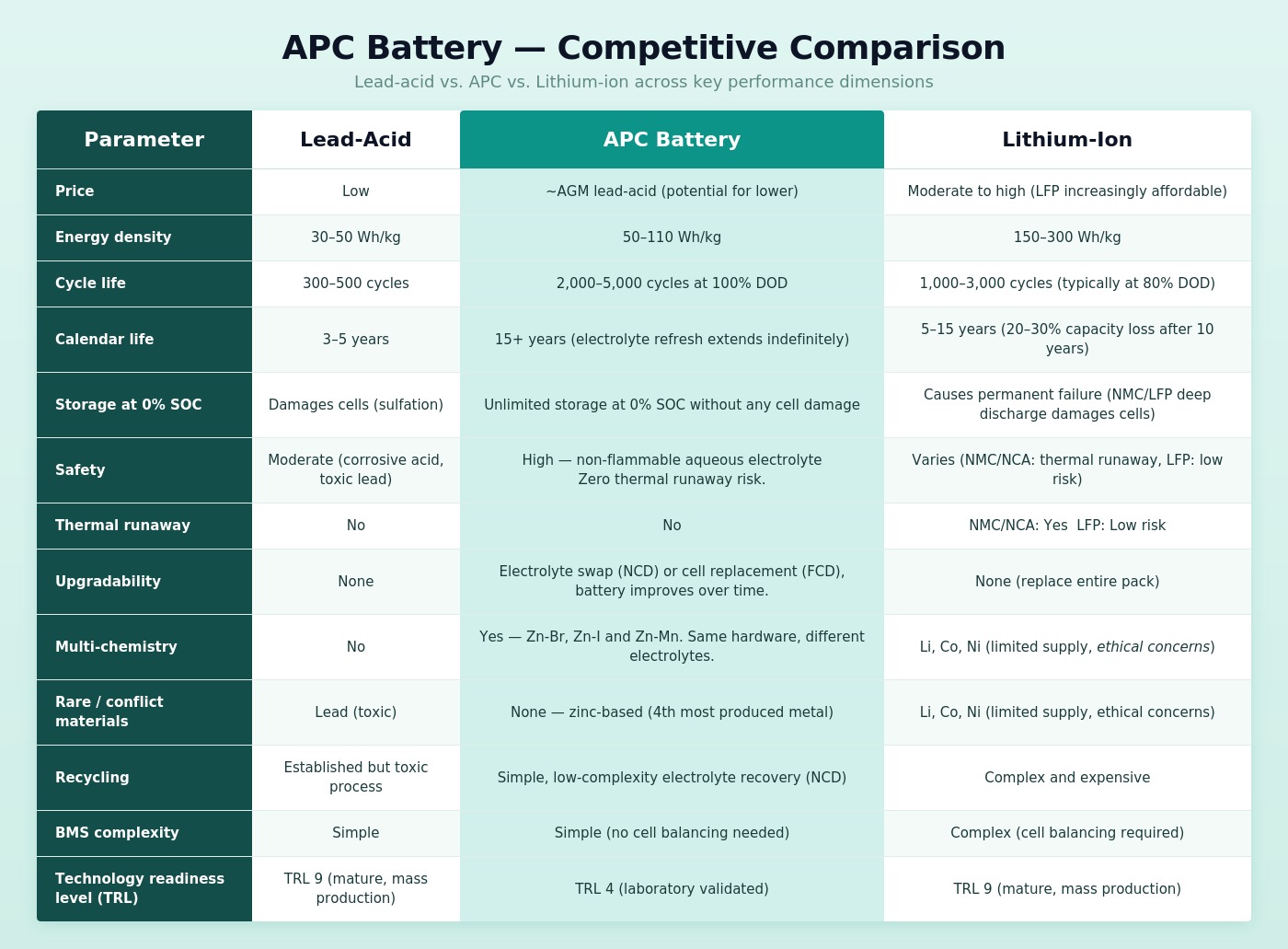
APC competitive comparison table
Note: APC Battery values are based on laboratory test cell measurements. These are R&D-stage figures and may differ from final product specifications as the technology scales.

Suitable wherever lead-acid is used.

The Hyperflow APC battery thus supports a wide range of applications and is suitable for almost any use where lead-acid batteries are currently used — from small to medium-sized energy storage systems, emergency and backup power, telecom and UPS infrastructure, to mobile solutions including marine, automotive, and DIY energy projects.

Small to medium energy storage Emergency and backup power Telecom infrastructure UPS systems Marine Automotive DIY energy projects
Active development updates.

Cayrex APC is in continuous development. Below is a chronological record of milestones — cell tests, electrolyte breakthroughs, and architectural iterations — that mark the path toward a market-ready product.

June 2026 FCD Architecture · V3 cell

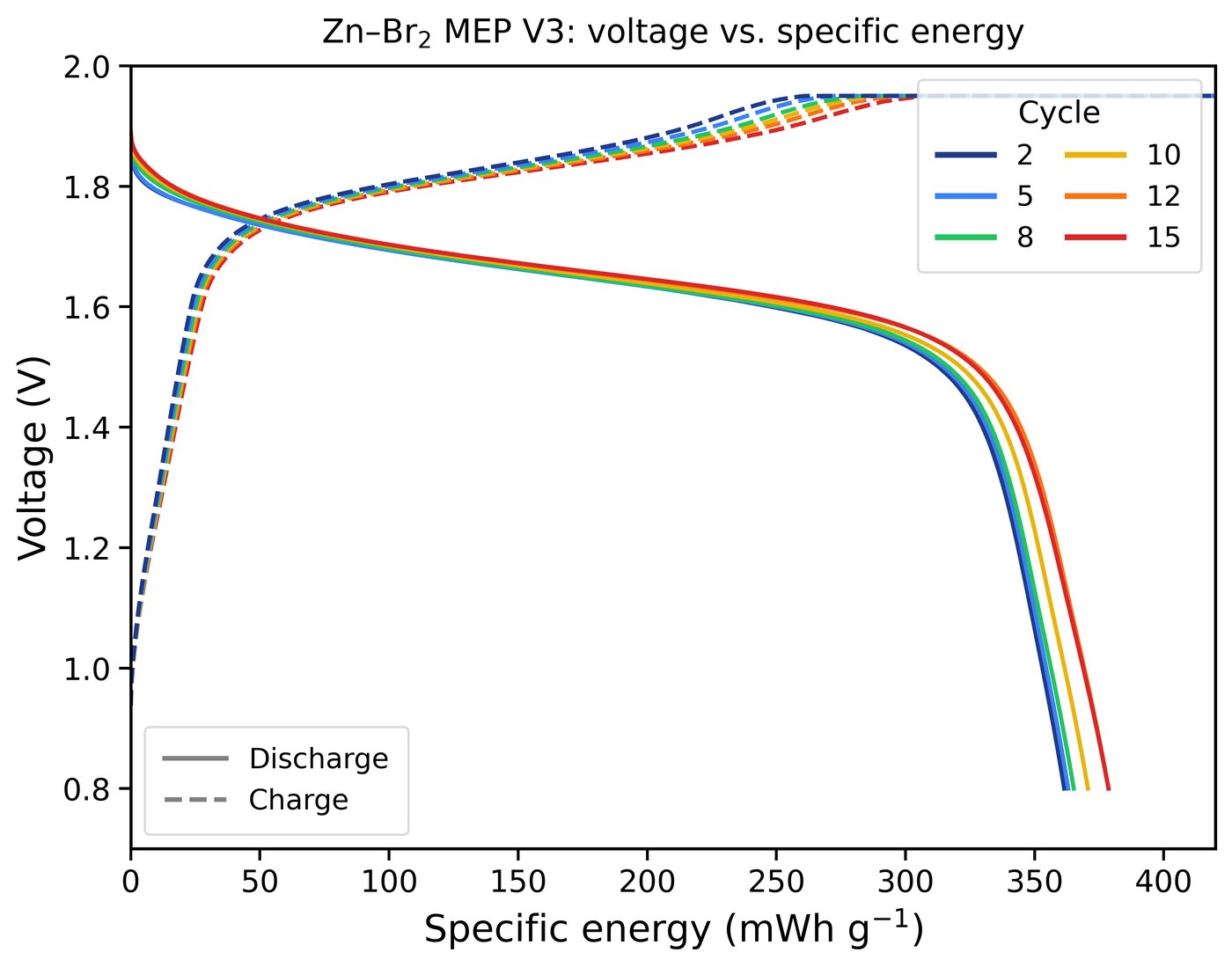
New High Performance V3 Zn-Br₂ cell — FCD architecture cycling test

New V3 cell based on the Fixed Cell Design (FCD) architecture, tested with a Zn–Br₂ M-C electrolyte. The voltage vs. specific energy curves show stable cycling behavior, reaching approximately 360–380 mWh/g at discharge — promising results for a static Zn-Br battery.

APC V3 Zn-Br2 FCD cell: voltage vs specific energy
Zn–Br₂ M-C V3 cell — voltage vs. specific energy. FCD architecture, June 2026.
November 2025 FCD Architecture · BCA comparison

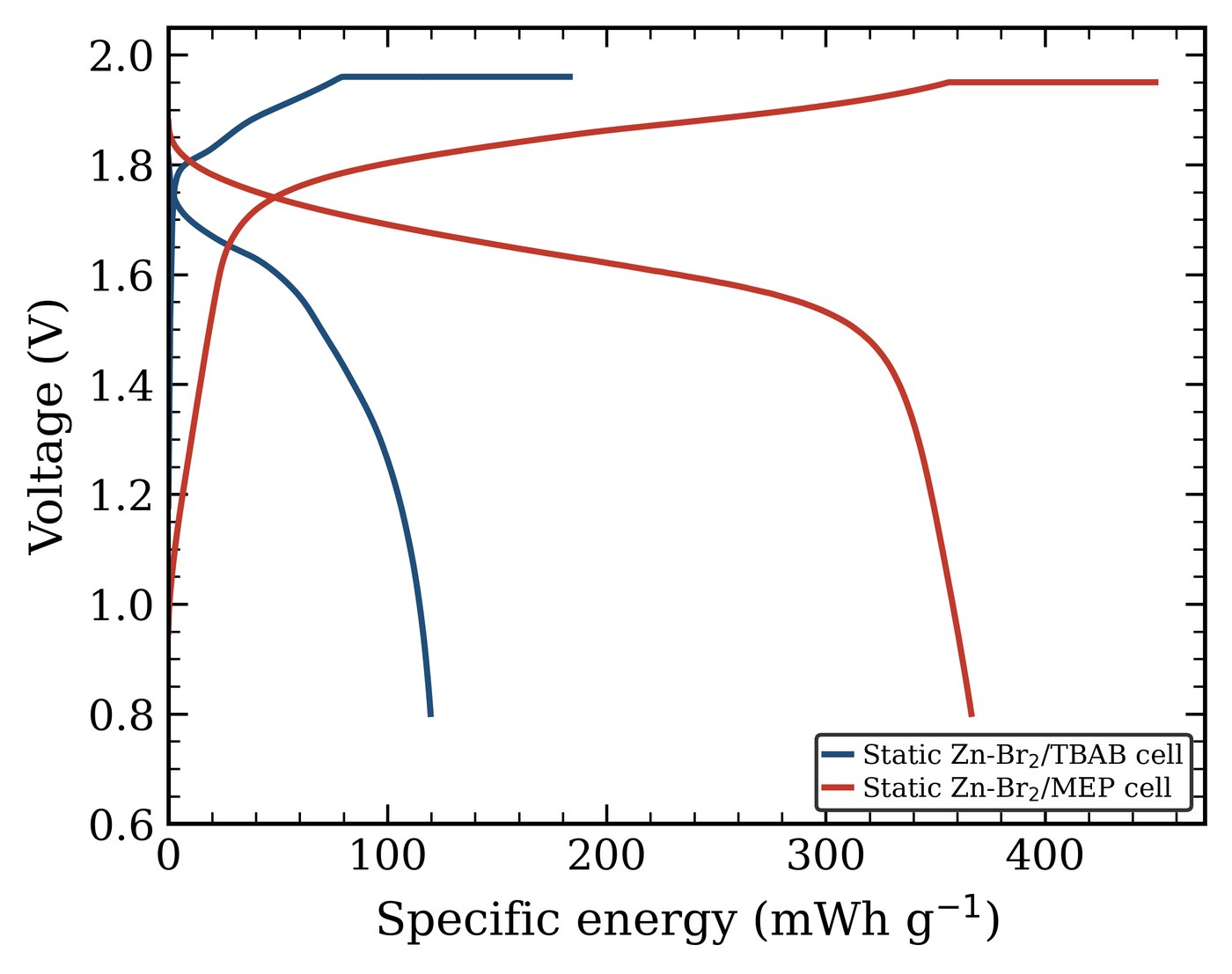
Static Zn–Br₂ FCD cells — TBAB vs. MEP electrolyte comparison

Side-by-side test of two static Fixed Cell Design (FCD) Zn–Br₂ cells using different bromine complexing agents (BCAs): TBAB (tetrabutylammonium bromide) and MEP (N-methyl-N-ethylpyrrolidinium bromide). The voltage-vs-specific-energy curves reveal a dramatic difference in achievable energy density: the MEP-based cell delivers ~360 mWh/g, roughly 3× more than the TBAB-based cell (~120 mWh/g). Both cells share the same FCD architecture, but the choice of BCA fundamentally shapes the energy storage capacity.

Voltage vs specific energy: static Zn-Br2 FCD cells with TBAB vs MEP BCA
Voltage vs. specific energy — static Zn–Br₂/TBAB cell (blue) vs. static Zn–Br₂/MEP cell (red). Both use FCD architecture.
September 2024 NCD Architecture · Electrolyte · Bromine management

Colloidal Zn–Br electrolyte for NCD cells — bromine sequestration without BCA additives

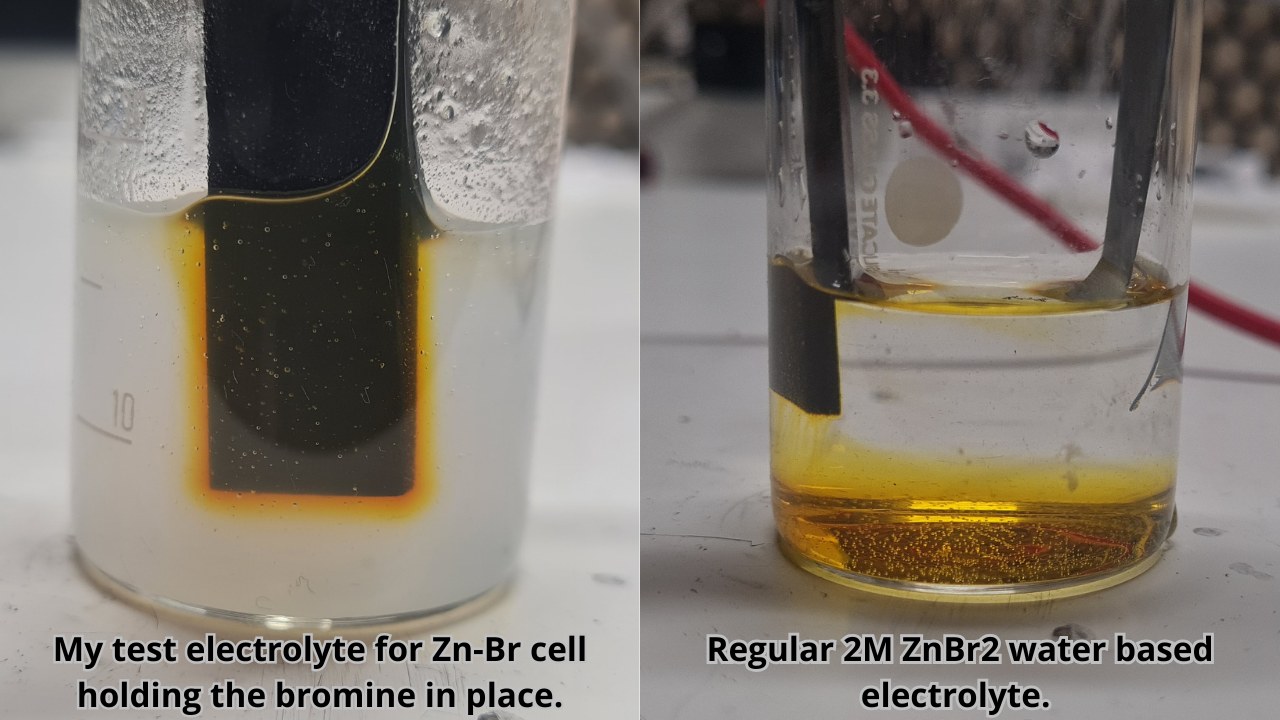
Test of a custom colloidal electrolyte formulation designed for the Neutral Cell Design (NCD) architecture, holding bromine in place without conventional bromine complexing agents (BCAs like MEP or TBAB). The left photo shows the colloidal electrolyte retaining bromine at the electrode surface — visibly clearer solution above. The right photo shows a regular 2 M ZnBr₂ aqueous electrolyte, where bromine diffuses throughout the cell and discolors the entire bulk.

Colloidal vs aqueous Zn-Br electrolyte: bromine retention comparison
Left: custom colloidal electrolyte (NCD architecture) holding bromine at the electrode. Right: standard 2 M ZnBr₂ aqueous electrolyte with bromine diffusion throughout.

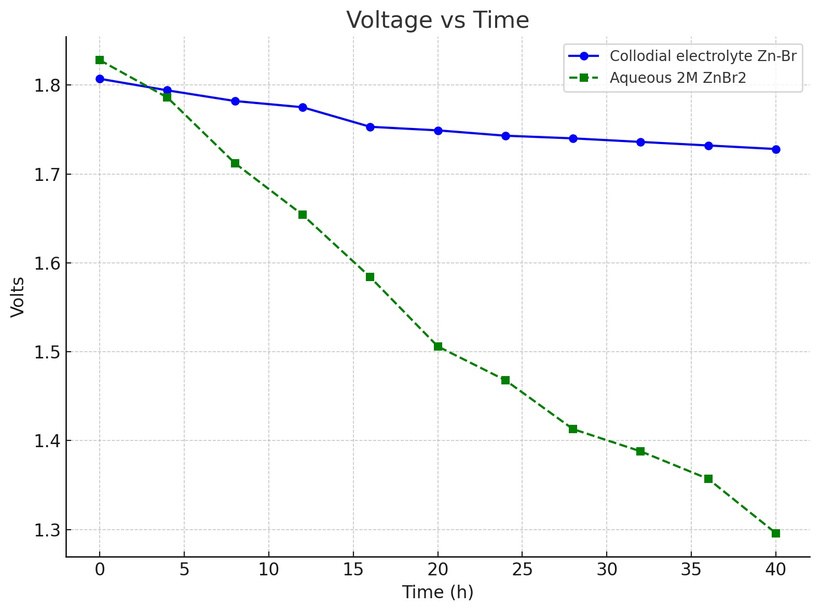
The voltage-vs-time curves over a 40 h period further confirm the benefit: the colloidal electrolyte (blue) maintains voltage above 1.72 V for the entire test, while the standard aqueous 2 M ZnBr₂ (green) drops below 1.3 V — a clear indicator of bromine crossover and self-discharge in the conventional formulation.

Voltage vs time: colloidal Zn-Br vs aqueous 2M ZnBr2
Voltage vs. time over 40 hours — colloidal Zn–Br vs. aqueous 2 M ZnBr₂.

Replacing the lead-acid stack.

Telecom operators, UPS integrators, system installers — APC is the compact, static version of our Hyperflow technology, designed as a drop-in replacement for lead-acid batteries.